Janus’ Journal #2 – By Hugh Wilkins
Tagging, Man-Marking. A deliberate sporting tactic that aims to completely neutralise an opposition’s best player, and their impact with the ball. When a player gets free reign within a game, the tagger ensures that players who can break open a game, need to become conscious, aware, assured in their decision-making. All of a sudden, what once was an arena for them to play purely and freely, is replaced with a dogged, determined and dedicated player breathing down your neck, whose sole purpose, is to negate you. Never mind the ball, the tagger’s mission first and foremost, is to stop their target through any means necessary. They are hitmen, silent and unsung assassins, and as a sports consumer, I love them.
It makes logistical and tactical sense. By eliminating an opposition’s best player, coaches attempt to stem their ability to influence and oftentimes win the game. In AFL tagging has made a bit of a resurgence, particularly in the middle of the ground, where offensive movements are often decided.
The nightmares of star players, this article will discuss and celebrate the work of some of the toughest, hardest and fittest players whose credit and ability often goes unrecognised. Here’s to the taggers…
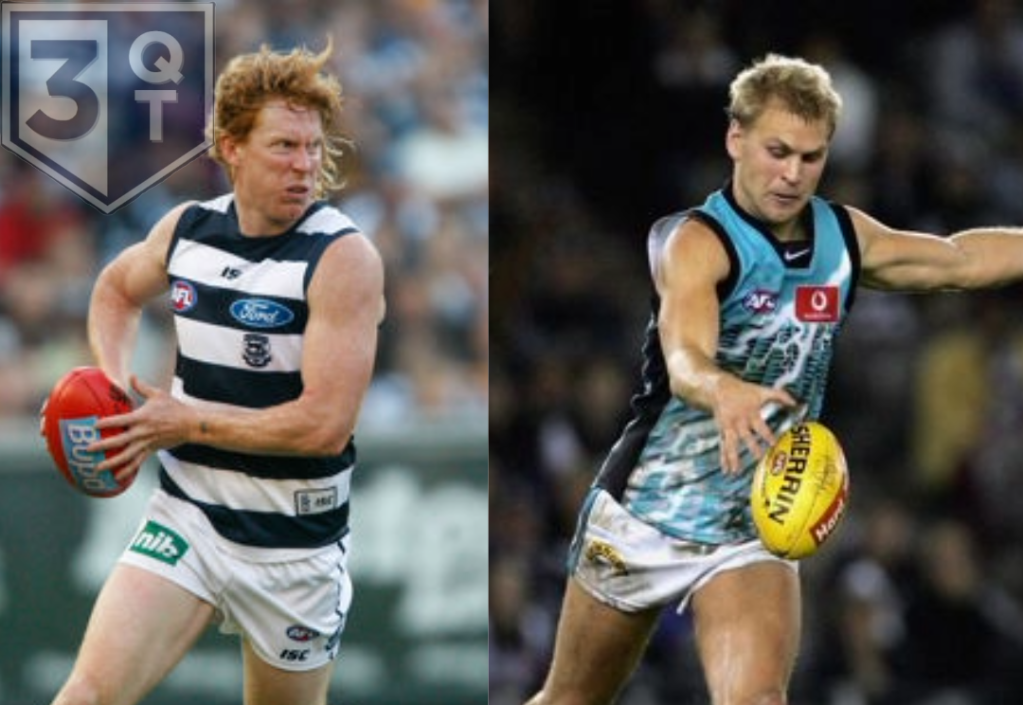
Cameron Ling:
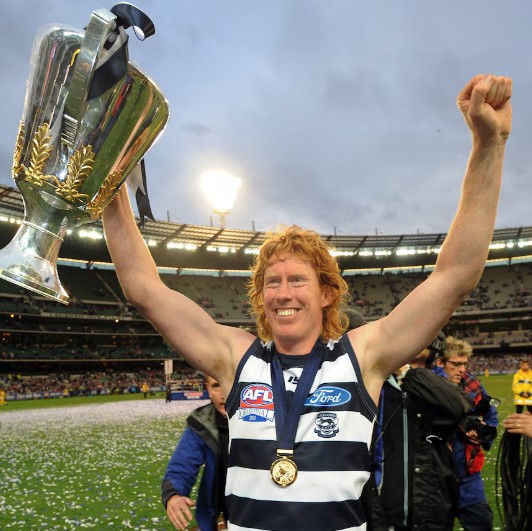
Geelong 2011 Premiership Captain, the auburn assassin, the mayor of Geelong, Cameron Ling was the nightmare of many star midfielders in the mid 2000s. One of the best in the tagging role, Ling was adept at quelling the impact of the opposition’s best midfielder, without sacrificing himself. Ling was incredibly capable of winning his own football, and becoming offensively involved in team-first, corridor movement which greatly characterised the 2007-2011 Geelong side.
When I think of Ling, my first thought always goes to his role on Nathan Buckley, as Collingwood played Geelong in Round 15 2002. Ling had been an interminable pest to Buckley (who later won the 2002 Norm Smith Medal in a losing Grand Final), checking him closely, and greatly restricting his effectiveness. Buckley, receiving a cut above his eyebrow, was told to leave the field under the blood rule, and in an act of frustrated desperation, rubbed his bleeding eye on Ling’s guernsey to apply the blood rule to his assassin. Geelong, leading all afternoon — in part due to Ling’s restrictions on Buckley, ensured Geelong ran away 28 point winners at the MCG, giving Ling the nickname “Ling the Cling”.
In the 2011 Grand Final, also against Collingwood, Ling was tasked with quelling 2011 Brownlow Medallist, Dane Swan. Swan, who had been averaging 32 disposals in 2011, was greatly inhibited, to only 20 disposals and 6 clearances. Moreover, Ling was able to amass 20 of his own disposals, which was capitalised by, as Stephen Quartermain put it; “a sweet goal to Cameron Ling” as he snapped around his body to seal the game with the last goal of the 2011 Grand Final.
A dogged competitor, players like Buckley and Swan have attributed Cameron Ling as one of the hardest opponents they have played on. An ever-present pest, whose toughness over the ball, tenacity within the contest and capacity to run his targets ragged, ensured he is remembered as one of the best taggers of the modern era.
Kane Cornes:
No discussion about tagging in the AFL would be complete without Kane Cornes.
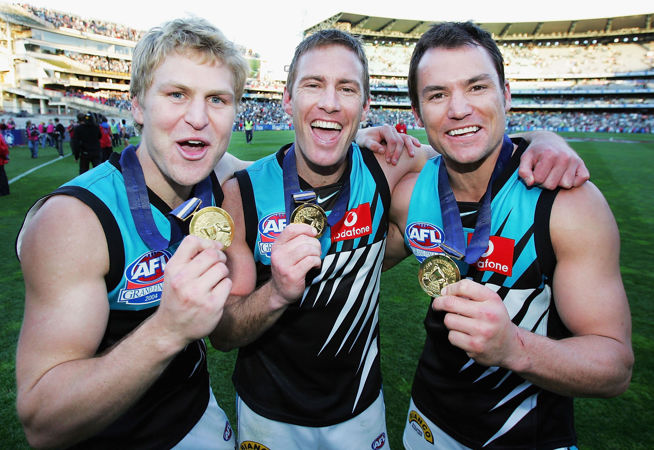
Before the topical, controversial and unwavering media personality, Kane Cornes was a hard-running, accountable midfielder for Port Adelaide. A four times John Cahill Winner, two-times All-Australian, a premiership and 300 game player for Port Adelaide, Cornes’ career was one defined by his doggedness and endurance, which were key attributes highlighting his skilfulness as a tagger.
Cornes, an elite runner; had incredible endurance and a versatile ability to slot into wherever the team needed him. However, like Ling, Cornes’ effectiveness as a tagger also came from his ability to win his own footy, and contribute to Port both as a defensive outlet, or an offensive contributor. Always dedicated to the cause, Cornes had many duels with some of the competitions best midfielders like Gary Ablett Jr, Sam Mitchell and Daniel Kerr.
But Cornes’ best tagging role undoubtedly came in the most important game in Port’s history. The 2004 Grand Final. Cornes was sent to Simon Black, the 2002 Brownlow Medallist and 2003 Norm Smith Medallist. Black’s impact on that Brisbane team was palpable, winning the 2003 Norm Smith with a monstrous 39 disposals. Enter, Kane Cornes. The brash and brazen 21-year-old was given Black as his assignment on the biggest stage; and he succeeded. Black, who had been so damaging the Grand Final previous, was suffocated to just 15 disposals by Cornes’ incessant presence. The asphyxiation of Simon Black thus allowed Port to run away 40 point winners and end Brisbane’s dominant dynasty.
Tagging and its return in modern-day AFL:
In AFL nowadays, there has been a noticeable resurgence to the prominence of the tag. In a game that has been increasingly decided by the work of the midfielders, coaches are now far more likely to account for those All-Australian quality players that can hurt them late.
The game has changed, and players need to be adaptable. When certain players are getting off the chain early, coaches need to be able to pull a switch on the fly, and ensure they can have someone responsible for these players — especially if there is no designated tagger on the team. Players like Alex Neal-Bullen (ADL), Jarrod Berry (BRI), Josh Dunkley (BRI), Conor Nash (HAW) and Mark O’Connor (GEEL) have been vital instruments to nullify the impact of some of the league’s most dangerous players.
I interpret the tagging role different to most. To me, they are hitmen, assassins, mercenaries. Their entire job is to break the spirit of their direct opponent, a return to one on one football in the time of zone/team systems. Imagine them as the seeker in Harry Potter. Their entire role concerns a completely different task from the rest of the team, but they can be immensely vital in victory. Whilst critics will often use statistics to identify whether a player has been well stopped; statistics don’t convey the success of the tag, as they cannot quantify the restriction of these players influence. Any player can get junk possessions, but it is their effectiveness that is inhibited.
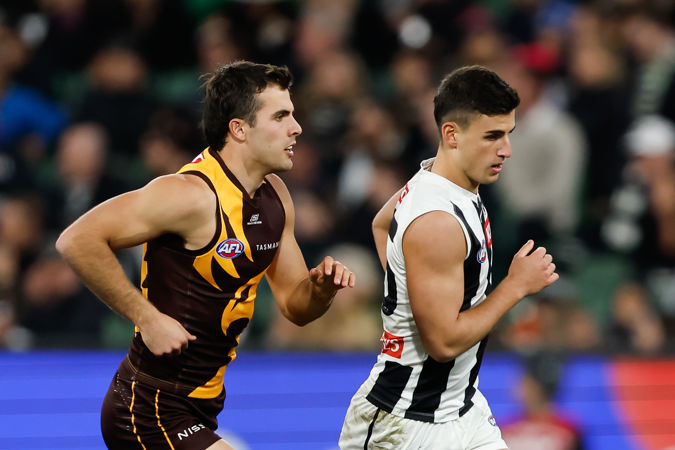
There is nothing better than a team with a designated tagger. Hawthorn have recently relied on Finn Maginness to nullify the danger of Nick Daicos. His 2023 suffocation on Nick Daicos ensured the then Brownlow favourite was starved, restricted to only 5 disposals and 1 clearance. The tag was so successful that Daicos rested forward to shrug Maginness, which ultimately resulted in his early substitution after a collision with James Blanck. Maginness’ assassination of Daicos was pivotal coaching that helped the 16th placed Hawthorn run away 32 point winners against the Ladder Leaders — and probably was the reason Daicos did not win the Brownlow Medal in 2023.
The arrival of Nick Daicos has almost necessitated the return of the tag in the modern game. Already a Rising Star, Premiership Player, two-time All-Australian and Collingwood Best and Fairest in only his fourth year, he is a pure talent that defines the chemical makeup of Craig Mcrae’s Collingwood.
The Daicos effect has now ensured some coaches really value the use of a tagger each week, not just for certain opponents. Geelong coach Chris Scott has largely given his Irish athlete Oisin Mullin some big shut down roles on players like Nick Daicos, Zak Butters and Jason Horne-Francis; all of which have been integral in some big wins. St Kilda’s Marcus Windhager is Ross Lyon’s resident ball-winning negator, with some immense scalps on Kysiah Pickett and Max Holmes being further complimented with high disposals and an ability to hit the scoreboard. GWS’ Toby Bedford is Adam Kingsley’s tagging talisman, beginning his defensive accountability with a shutdown role on Zak Butters Round 14 2024. Bedford found his niche with this role, with his most notable shutdowns of players like Lachie Neale (2024) and Nick Daicos in Opening Round 2025 being particularly effective.
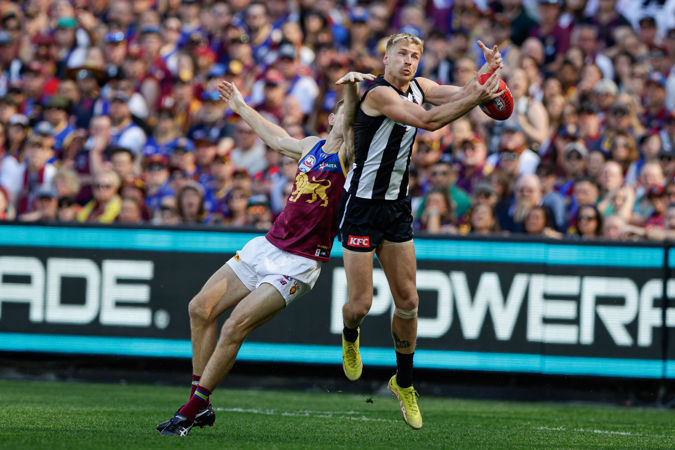
But, there is one tagging performance of recent memory that I believe was a critically deciding factor in the last day of September. Collingwood do not win the 2023 Grand Final against Brisbane without Billy Frampton’s work in negating Harris Andrews. Whilst Frampton’s statistical output (2 disposals) is often compared against Andrews’ relatively impactful game (16 disposals and 9 marks), Frampton’s influence is seen in his presence. Frampton’s role was purely negation, and in keeping Andrews defensively honest to limit his defensive impact. Frampton’s role as a decoy to occupy Andrew’s attention was vital in allowing Collingwood to score through other means, with Norm Smith Medallist Bobby Hill kicking 4 goals, as Brisbane’s best intercept defender remained occupied by the interminable Frampton. Frampton is a player that thrives with a sole directive. When given a direct responsibility, a direct opponent, he excels, and his Grand Final performance is perfectly indicative of this trait, greatly influencing the 2023 Grand Final, and etching himself into Collingwood folklore, forever.
ThreeQuarterTime is built on the celebration of the Unsung Heroes, to applaud the tactics and strategies that may not necessarily be the sexiest. But, there is something poetic, something pure, about one on one matchups in team sport. About watching two players tussle in physical bouts, where only the strongest, fastest and fittest can survive and thrive. Taggers can prove that the best star players, can bleed — and if it can bleed, teams can kill it.


 ThreeQuarterTime
Leave a reply to Anonymous Cancel reply