Tag: history

  • The Greatest Ashes Moments: Edgbaston, 2005.

    The Greatest Ashes Moments: Edgbaston, 2005.

    Janus’ Journal #6- By Hugh Wilkins

    The Ashes. Australia. England. It is undoubtedly one of sports fiercest rivalries. A battle that creates furore, drama, anger, spite, but most important of all, entertainment.

    It arguably creates the greatest spectacle within the cricketing sphere. I understand that India and Pakistan fans will probably disagree with me, but those matches often descend into utter chaos, and become more than just a cricket match. The Ashes however showcases all the greatest elements of test cricket. Test cricket is the greatest format; five days, infinite possibility, and the Ashes always offers the opportunity to revive its prominence back into public consciousness.

    Regardless of form, nothing is predictable and anything can happen, which creates a canvas that spurs on any Australian and English cricketer to mythologise themselves into the annals of cricketing folklore.

    Join me over the summer of cricket, as in celebration of the upcoming 25/26 Ashes series, I will be covering some of the most iconic Ashes moments, beginning with the 2005 Edgbaston test match.

    Edgbaston, The Ashes (2005), Second Test Match:

    For any cricket fan, the 2005 Ashes series, fought in England, elicits the purity of test cricket. It had everything. Heroic performances with the bat and ball, dogged fight in the midst of batting collapses, and scintillating partnerships. Most of all, each game was an agonising display of grit, with incredibly tight finishes. This series highlights the momentum of sport, and the captivating battle that comes with a team trying to dig in and fight in the midst of relentless bombardment.

    Arguably the most iconic test match of this series was the second one, held at Edgbaston. Australia were 1-0 in the series after Glenn McGrath’s nine wicket haul and man of the match performance gave Michael Clarke the canvas to steer Australia to a 239 run victory at Lord’s.

    But McGrath was injured hours before the Edgbaston test in a pre-game warmup. All of a sudden, after a thumping defeat, the pendulum slowly ticked into England’s favour. Now, England did not need to face McGrath’s thunderous new ball deliveries, and the omen that the team that won the toss should bowl first was immediately inversed. Where McGrath had enforced an immense batting collapse in England’s first innings at Lords (with the first 16 overs resulting in a scoresheet of 5-21); English openers Marcus Trescothick and Andrew Strauss made a clear statement, using the rapid Edgbaston outfield to allow their powerful cover drives to sail away for boundaries (and punishing the incumbent new ball bowlers). Their power hitting created an incredibly different scorecard to the first test match, rapidly rising to a hundred partnership for no loss. After being punished around the ground, Australia brought on Warne to bowl in the 25th over. Even though Warne had been hit for six early by Strauss, his mastery of turning the ball sent a ball placed on the leg side careening into off-stump. Trescothick still sailed, but a tentative tickle at McGrath’s replacement Michael Kasprowicz was caught behind by wicketkeeper Adam Gilchrist, and after the soaring speed of the English openers, the time to strike for Australia was now.

    England’s Marcus Trescothick sweeping with aggression, which helped him make a first innings 90

    Australia took wickets in quick succession, dismissing a rash Michael Vaughan, which brought all-rounder Andrew (Freddie) Flintoff to the crease. Sensing blood, Australia’s Brett Lee directed Flintoff with vigorous bouncers, trying to inhibit Flintoff’s dangerously fast scoring as the sixth batsman, but Flintoff’s reactive and defensive pulling of Brett Lee for six was indicative of his stabilising half century. Combining with England’s Kevin Pietersen, the pair were able to hold the line, and dish it out in a controlling and intense manner. Flintoff finished the first innings with 68 off 62 balls, Pietersen with 71 off 76.

    After bowling England all out for 407; Australia sent openers Matthew Hayden and Justin Langer out in hopes that they could set the tone. Hayden, the flamboyant cowboy. Langer, the gritty warrior. Unfortunately for Australia, Hayden’s showmanship saw him come down the ground first ball to be dismissed for a golden duck. Ponting thus had to come in, and play with the flash which worked incredibly for England in their first batting innings, as well as to enable Langer’s dogged methodism to anchor the innings. The partnership between Ponting and Langer defined Australia’s first batting innings. Ponting dictated the speed of his game with his trademark pull-shots and cover driving at will, making a vital 62 off 76; accelerating Australia’s total to account for Hayden’s ephemeral departure. Langer meanwhile fought with his trademark boxers mentality; never flashy, always gritty, and his body-on-the-line mindset was pivotal to attempt to stabilise Australia. After Langer was trapped by the fast and full pace of English paceman Simon Jones, his departure for a determined 82 off 154 resulted in a lower order batting collapse and Australia were bowled out for 308.
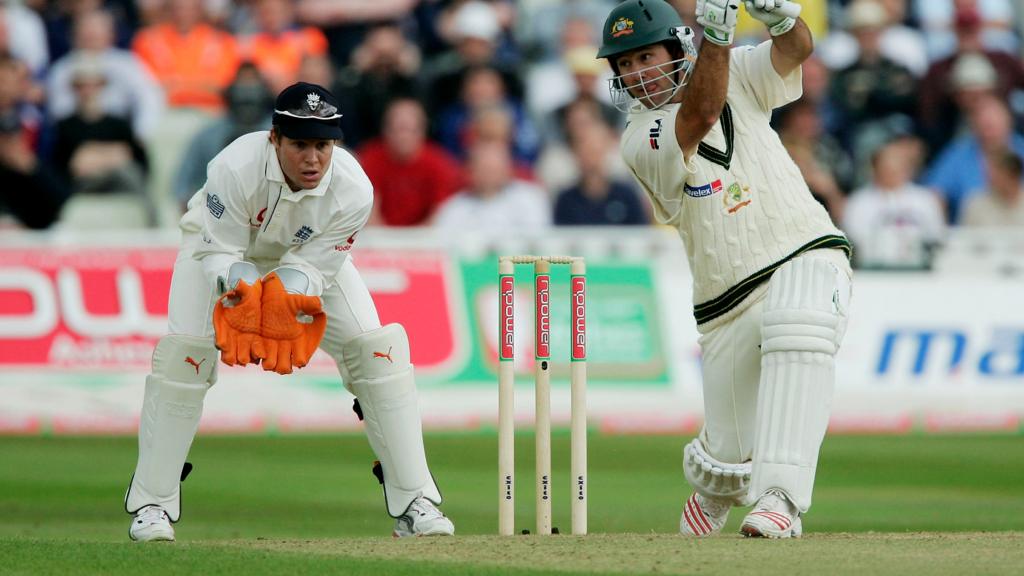
    Ricky Ponting driving a delivery as Australia sought to bounce back following opener Matthew Hayden’s golden duck dismissal on day 2.

    With a 99 run lead to begin their second innings; England had a favourable platform to push their total into difficult waters for Australia to chase. They just had to play with the lively freedom of the first innings. But that is not how sport works. Whilst it appeared that England’s Marcus Trescothick’s vitriolic dispatching of Brett Lee’s first delivery through extra cover for 4 runs would be indicative of the English mentality, England would instead face a bowling onslaught. The inimitable Shane Warne fooled Andrew Strauss yet again in the sixth over, and Marcus Trescothick tickled a wider delivery from Brett Lee straight to Australia’s wicketkeeper in Adam Gilchrist in the 11th over. Where Strauss and Trescothick had been an opening thorn in the Australian’s side, surging to a hundred partnership, they had suddenly been dismissed in quick succession for only 27 runs combined.

    Shane Warne and the Australian Cricket Team celebrating after the wicket of Andrew Strauss, who fell victim to Warne in both innings.

    English captain Michael Vaughan fell a similar victim, and was also dismissed in the 11th over, clean-bowled by the pace of Brett Lee. Where Lee had been dispatched in the early stages of England’s first innings, he was slowly and dangerously asserting himself in England’s second innings. This amounted to his dismissal of English nightwatchman Matthew Hoggard, as Lee instituted a mini-batting collapse at the end of the day’s play.

    What then followed was the Shane Warne show. Taking his good mate Kevin Pietersen again after clipping his pad for a tough Adam Gilchrist catch was quickly followed two overs later as Ian Bell was similarly caught by Gilchrist off a Warne delivery. Warne got revenge on fellow spinner Ashley Giles (who got him out in the first innings), and hit Steve Harmison with a full delivery flicked to Ponting in the slips.

    However, Freddie Flintoff remained, dictating the innings with ascendant scoring despite the growing casualties. Last man Simon Jones was able to keep Flintoff on strike and a licence to smash sixes around the ground. Warne ultimately got him, but Flintoff’s 73 off 86 meant England were all out for 182, rather than 131.

    Andrew “Freddie” Flintoff smashing a ball for six as he anchored England’s second innings total amidst a dangerous Australian bowling attack.

    Australia were chasing 282 to win. The opening partnership between Langer and Hayden started well in the first 10 overs. Langer working to pull quick bouncers on the back foot, and Hayden characteristically coming down the wicket for big cover drives. But just when it was looking like Australia had the momentum in their corner, England sent on their talismanic Prestonite, Freddie Flintoff. His wicked pace outfoxed Langer, rising through the gate and crashing onto his stumps in the second ball of 12th over. But that was not all for the 12th over, as what followed was an over of bowling deliveries of assassin-like intensity, as Flintoff sought to bully and lethally dispose of the new man at the crease, Ricky Ponting. Flintoff, relentlessly hunting, goaded Ponting into playing tempting shots before tightening him up in a bid to encourage him to play. He sought to bully Ponting, and he did, toying with his pride. Attempting to get off the mark and fight back at Flintoff, Ponting threw his bat at a ball that pitched up, but swung away, catching an outside edge going straight to English wicketkeeper Graham Jones, exiting for no runs after facing a venomous five ball spell that set the tone for England’s mid session dominance, as they sought to wrap up the second test match and to level the series at 1-1.

    Matthew Hayden, Damien Martyn and Simon Katich all departed quickly within five overs of each other. Adam Gilchrist, Australia’s wicketkeeper batsman who could pile on runs with reckless abandon, was out cheaply without as much as whimper within 4 balls. The English could taste the Australian blood after ripping through their batting lineup. The momentum, and the game, was now in the English’s hands.

    But, as is emblematic of this specific match, when the times got tough, it took grit and fight to get the game back on level terms. Playing for Australia elicits a historical pride, particularly through the reflection between sport and the ANZACs. Where the ANZACs, whose sacrifice, bravery and mateship developed Australia’s national identity; playing for Australia honours the sacrifice and furthers that national pride evoked by these qualities. Like the ANZACs, sometimes you just need to dig in, grit your teeth, and fight through the overwhelming punishment in a process of eternal endurance. That is exactly what defined the remaining 20 overs of this game, as Brett Lee and Shane Warne, the bowlers who had torn through England in their second innings, suddenly found themselves holding the line in the trenches of that Edgbaston wicket; amidst the torrent of baneful deliveries to fight for their lives. Lee and Warne had both been a part of the Australian team that travelled to Gallipoli before the 2001 Ashes series, led by captain Steve Waugh, who sought to elicit a profound appreciation for the ANZAC sacrifice, and an understanding of what it means to represent your country. They channelled this profundity into their unyielding mentality, and although the English threw the kitchen sink at the two, still they remained, determined. Wearing the punishment of the cricket ball with the courage and grit becoming of the ANZACs.
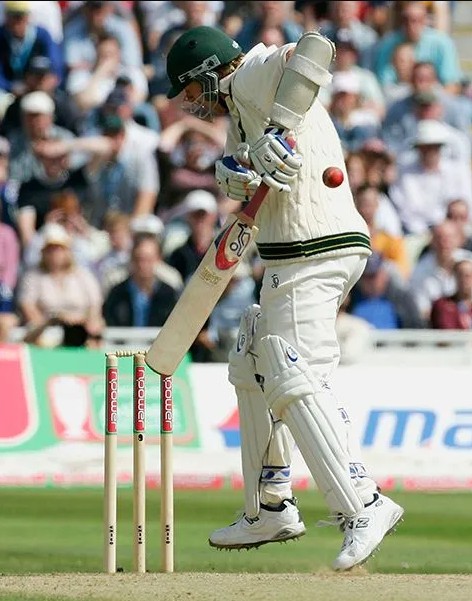
    Brett Lee absorbing the cricket ball with his body with the grit that defined his batting innings and reflected his ANZAC mentality.

    Fortunes seemed to shift in the English favour when the lionhearted Warne was pushed backwards by a Flintoff delivery which caused him to trollop on his own stumps. But, last man and last minute replacement, Michael Kaspowicz was tenacious with Brett Lee to maintain the Australian fight, playing big shots to further pressurise the English attack. It seemed to work, with their gumption keeping momentum in Australia’s hands: A Kaspowicz shot to third man is almost caught by Simon Jones. An inside edge from Brett Lee is inches away from the stumps and beats the keeper for 4 runs. A Flintoff no ball is flicked on for 4 by Lee. The fortitude of Lee and Kaspowicz lead to Australia only needing 4 runs to win. Lee was able to strike the ball through cover and it appeared to sail to the boundary, but was fielded for a single, placing Kaspowicz on strike, and Australia needing 3 runs to win. Ultimately, Kaspowicz was caught by surprise by the Harmison delivery, suddenly rising on him in defence as Geraint Jones took an impressive diving catch to give England a 2 run victory over Australia. A dramatic finish to an all-time classic test match.

    In what was an epic test match, one of immense courage, fight and class, it will always be indemnified by one image. That of Freddie Flintoff; who was awarded man of the match for his contributions with bat (68 & 72) and ball (3 & 4), humble in victory by consoling the valiant Brett Lee in a sign of incredible sportsmanship that truly highlights this game in the annals of the spirit of cricket.
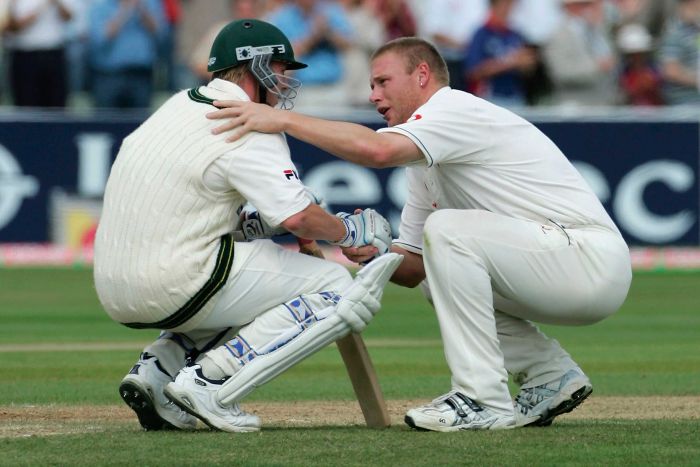
    A heroic Brett Lee consoled in defeat by the humble Andrew Flintoff, who was awarded Man of the Match.

  • In praise of Geelong’s Irish Experiment

    In praise of Geelong’s Irish Experiment

    Janus Journal #1 – By Hugh Wilkins

    The Irish experiment. For some fans, the thought of the Irish players breeds excitement. For others, the Irish players are a source of frustration. But for me, the Irish players come to represent more than just the game.

    I feel a kindred spirit with the AFL’s Celtic warriors. A connection. I am not Irish myself, but I identify with these players because I can identify and relate to their experiences greater than the typical draftee. You must understand, my love for AFL has only blossomed in the last six years. Despite my constant exposure to AFL (for my Dad was a coach), I only truly began to appreciate it from a perspective of consciousness. Thus, my identification with the Irish imports can be understood. Like them, I am also learning the game; learning the nuances and intricacies, but also learning to love it from a conscious perspective.

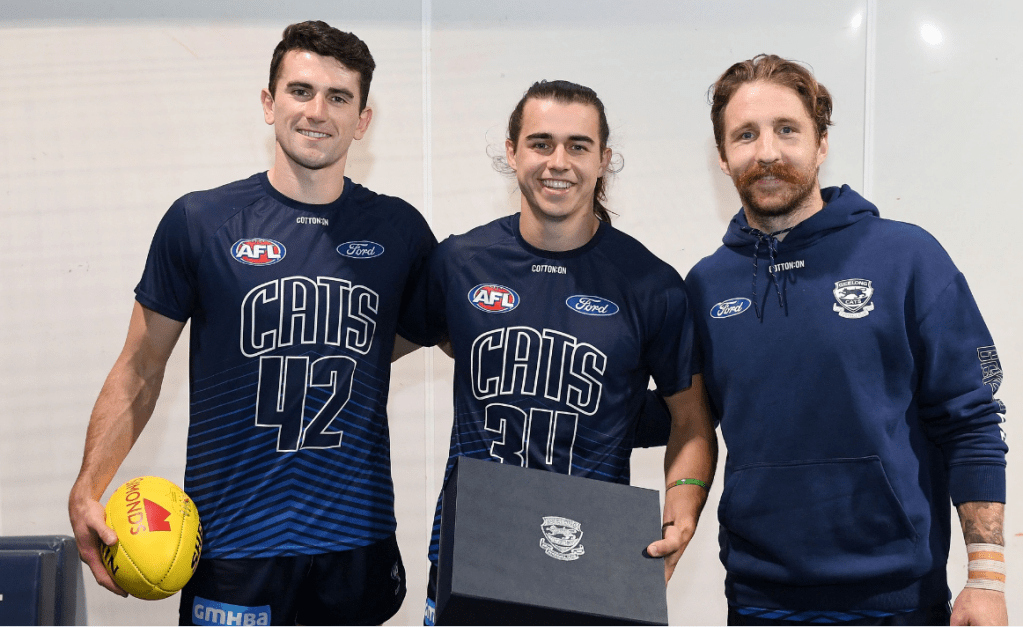
    Luckily for me, Geelong, my team, has a strong history of engaging in this Irish experiment, starting particularly towards the end of the 2016 season, when Zach Tuohy requested a trade from Carlton to Geelong. Along with this, Geelong selected Mark O’Connor from Kerry GAA as a Category B Rookie in October 2016. Both Tuohy (Round 1: Fremantle) and O’Connor (Round 7: Essendon) made their club debuts in 2017, and have become immortalised as stalwart defenders and, most notably, Geelong Premiership Players (2022). Subsequently, Geelong have continued delving into the Irish pool with their selection of Oisin Mullin as a Category B Rookie from County Mayo (Initially in 2021, before eventually coming to Geelong in 2023). This trend has continued even today- as the Cats have filled the Irish void left by Tuohy’s retirement with the Category B Recruitment of youngster Cillian Burke.

    That’s the thing with the Irish. AFL clubs will continue to look down this avenue due to its historical successes, and the capacity to bring through already hardened, tough, resilient and athletic players who have shown a capacity to quickly adapt to the similar, but different, rigours of AFL Football.

    So, forgive the long article, but please indulge me as I wax lyrical about Geelong’s Irish players, and how they have had an impact on me as a Geelong supporter.

    Zach Tuohy

    1x Premiership Player (2022)

    1x All-Australian (2015)

    The frolicking Irishman, with a booming right peg and a penchant for a barrel. Initially drafted by Carlton in 2010 (pick 73 in the Rookie Draft) from his native Portlaoise- Tuohy gradually developed into a consistent, reliable and memorable player. Like most Irishmen, he learnt the trade as a tagger, before slowly drifting into his half-back role with a tendency to roll forward and use his thumping kick to bomb goals from 50; Tuohy’s first goal for Geelong against Fremantle comes to mind (2017).

    For me, I took notice of Tuohy in his time at Geelong. His windswept hair and voluminous moustache made him an instant cult figure. A real heart and soul player that fought for the jumper, the Cats stood taller with Tuohy in the half-back line. A mobile half-back with drive and desire to push up the ground. His mobility correlated with his tackling ability and his wiliness around goal. His Gaelic attributes enabled his craftiness around goal. Look up his two goals within 2 minutes against Brisbane in 2021; a one point win for the Cats. The first showcased Tuohy’s Gaelic capacity to step through traffic, weaving through both Charlie Cameron and Hugh McCluggage for an impressive leaning goal. The second was indicative of Tuohy’s hard running capacity and ability to stay dangerous within the same contest- feeding a handball to Shaun Higgins on the boundary line and getting it back with a no looker for a cheeky checkside goal.

    What struck me about Tuohy was his embracing of physicality. Playing against Western Bulldogs at Marvel Stadium in 2022, Tuohy told Bailey Smith where he could shove it amidst a Three Quarter Time fracas from some Bulldogs players against Rhys Stanley. Tuohy, first to the scene, defended the ruckman, resulting in an iconic, fierce and fiery altercation with Bailey Smith as he ended up headbutting Tuohy.

    But that’s what you got with Tuohy. A fire that burnt as bright as his hair. A fire that could not be snuffed out. One of the most passionate players I have ever seen.

    His reliability and consistency could be seen in his eventual surpassing of the great Jim Stynes record for most games played by an Irish player.

    Tuohy has many iconic moments in the annals of Geelong’s history (His classic Irish jig whenever he kicked a goal or his 250th Game being the Grand Final against Sydney in 2022). But his most notable moment has to be his goal after the siren against Melbourne in 2018. Going into the last term, Geelong where down by 23 points, were a last ditch effort to win the game with a minute to go came from a bold kick in board from Daniel Menzel to Tom Hawkins (who kicked four in the last quarter), to get it to Mitch Duncan, with a foray kick forward to find a now forward Tuohy who takes an aerially powerful contested mark and converted after the siren to win by two points.

    Mark O’Connor:

    1x Premiership Player (2022)

    When compared to Tuohy, Mark O’Connor is a player that receives little to no fanfare. Instead, he has quietly and deliberately found his way into fairly consistent stints in the side. Debuting in 2017, and with 130+ games for the Cats; O’Connor has developed into a reliable and stalwart defender for the Cats.

    Like is apparent to most Irish players, O’Connor’s greatest attribute is his resolute physicality. Always temperate on the field- O’Connor is able to stoically complete his designated assignment. His defensive determination often goes unnoticed- but are often critical to the team’s success. His defensive physicality has become apparent in his willingness to staunchly tag (particularly memorable are his duels with Lachie Neale- Round 6, 2024, O’Connor was able to quell Neale’s influence and was even able to work hard in getting a goal himself), commit to contests as well as his ability to use his strength to help set up goals or get on the end of some team movement; which is exactly how he finds himself as a stalwart member of Geelong’s defensive setup. Look at O’Connor’s goals too. His Irish-ness allows for the capacity to flush them on the run, or craftily snap around his body (O’Connor’s goal against Melbourne or the Bulldogs in 2020 come to mind).

    A reserved and commanding member of Geelong’s backline, he plays with a stoic seriousness that reflects his intensity and physicality. That’s what strikes me about O’Connor. His quite-ness is indicative of his assuredness.

    In 2022, along with Zach Tuohy, O’Connor became a Premiership Player , with Tuohy and O’Connor becoming the second and third Irish players to play in a Premiership since Tadgh Kennelly (2005). In a game where not much was to be done defensively- O’Connor finished the game with 13 disposals at 92% efficiency; and most notably, getting a holding the ball tackle on James Rowbottom on the stroke of 50 to deny Sydney from adding another to their only solitary first quarter goal.

    Oisin Mullin

    The third player in this article is Oisin Mullin, a player that i will always staunchly defend. No matter how poor a game he plays, or how much certain fans think he is to blame for certain results, I will resolutely support and defend Mullin, for there he is an incredibly capable, dynamic and intelligent athlete who is still developing his understanding of the game, and is having to do so on the fly. As a new player still learning the game, he can become a whipping boy for Geelong fans, but there is something inspirational about seeing a player- far from his home, his family, learning a new game that is similar but deeply nuanced and confusing compared to the Gaelic Football he grew up with. How can you not be inspired by this?

    I think we are seeing an immense and positive step in the development of Oisin Mullin. To the outside eye, Oisin Mullin is an easy target for criticism, but I can see the potential that is gradually becoming more and more apparent. Mullin’s best feats have occurred as a tagger. In the Round 9 game against Port Adelaide at GMHBA Stadium, Port jumped the Cats to go into Quarter time with a 5 goal lead; spearheaded by the midfield destruction led by Horne-Francis (8 disposals, 4 score involvements, 1 goal, 3 clearances). Chris Scott dragged Ruckman Rhys Stanley and immediately inject Mullin onto the dangerous Horne-Francis. Despite the loss, Mullin was able quell the impact of Horne-Francis, nullifying him to only 2 score involvements and 4 clearances for the rest of the game; and this was the match where I became invested in the Oisin Mullin development. This match-up was also critical to Geelong’s thumping Qualifying Final against Port Adelaide. Away from home and with a late withdrawal from Tom Stewart- Mullin was brought into the side to again, sit on Horne-Francis and negate his influence.

    In Round 3, 2025, Mullin was placed on the dangerous Charlie Cameron; and after conceding a first quarter goal- locked in and was able to keep Cameron to only 7 disposals, and 2 score involvements, whilst Mullin himself had 15 disposals and 100% efficiency in a wet and slippery environment that probably suited his Gaelic attributes.

    In Round 7 2025 Mullin was tasked with Nick Daicos, a match up I watched quite intently whilst at the game. In the last quarter, with Geelong’s lead at a slender 7 points, Mullin persisted with the tag; and was able to effectively negate Daicos to only 3 disposals. Although Geelong was well within their rights to lose that game from a commanding position (Crisp missed after the siren), Mullin’s disablement of Daicos instrumentally denied his ability to find influence in the game in clutch moments where he historically breaks the game open as a game-winner.

    That is not to disregard his adapting development in the skills department. His most iconic moment surely must be his beautiful left foot hit up running on the Members wing to Brad Close who set up Ollie Henry for his third goal. Unfortunately, the game proved to be a heart-breaking Prelim defeat as the Cats were felled by the Lions by 10 points.

    Mullin is obviously highly rated internally by Geelong. He has found himself a consistent spot in the side in 2025, so Chris Scott evidently sees something in the developing Irishmen. Oisin bias aside. I genuinely do think it is only a matter of time before we see Oisin break the shackles of development and becomes a respected Irish footballer in the vein of Zach Tuohy. We have seen what he can do, and i believe he is more than just a flirting experiment. He is most valued and effective as of writing as a tagger- especially on midfield players. Oisin’s current position as a defender often leaves him an easy target for criticism; especially in losses. But, watching Mullin live, i do see an athlete with a resounding composure that just hasn’t found the capacity to release it yet. That’s why I believe no one should be surprised if they find Oisin spending far more time in the midfield. He is a tough and brick-walled with a tank for days for two way running. He has the capacity to attack the ball hard, and use his speed to burst or weave through contests, and with an ability to use his Gaelic attributes and natural speed to dexterously change his running patterns on a dime, but to also find targets with the cheeky, angled kicking synonymous with Geelong.

    At Gather Round this year, during a signing event, I even asked Oisin Mullin how he has found the change between Gaelic football and AFL. He spoke to it being a significant change compared to what he grew up playing. Following on, i asked whether he is enjoying, of which he said yes. He spoke to enjoying the challenge of learning this new game on the fly, in a competition where those who can’t adapt get spit out quite quickly. Thus, he has a fire inside, a competitive spirit and desire for adaption and gradual improvement each week.

    Obviously, this article mentions the Geelong Irishmen. I am a Geelong fan, sue me. But that is not to discount the presence of the Irish players around the league. Mark Keane is a regular defender for the Adelaide Crows, recently heroically saving the Showdown no.57 clash with his courageous back-with-the-flight contested mark with 1 minute to go (and his almost unintelligible post-match interview about “footy”). Conor Nash has become a resolute hard-nosed tackling midfielder for Hawthorn, and Connor McKenna, the former bomber, is a premiership player for Brisbane (2024). All of these players have found their footing in the AFL after times of significant development; of learning the game and its intricacies. This is why I relate to the Irish players, because like them, I am learning the game on the run, and it is a great exemplar of the value that the AFL, and Geelong in particular, have found via the Irish Experiment.