Tag: afl

  • The Art of the Tag

    The Art of the Tag

    Janus’ Journal #2 – By Hugh Wilkins

    Tagging, Man-Marking. A deliberate sporting tactic that aims to completely neutralise an opposition’s best player, and their impact with the ball. When a player gets free reign within a game, the tagger ensures that players who can break open a game, need to become conscious, aware, assured in their decision-making. All of a sudden, what once was an arena for them to play purely and freely, is replaced with a dogged, determined and dedicated player breathing down your neck, whose sole purpose, is to negate you. Never mind the ball, the tagger’s mission first and foremost, is to stop their target through any means necessary. They are hitmen, silent and unsung assassins, and as a sports consumer, I love them.

    It makes logistical and tactical sense. By eliminating an opposition’s best player, coaches attempt to stem their ability to influence and oftentimes win the game. In AFL tagging has made a bit of a resurgence, particularly in the middle of the ground, where offensive movements are often decided.

    The nightmares of star players, this article will discuss and celebrate the work of some of the toughest, hardest and fittest players whose credit and ability often goes unrecognised. Here’s to the taggers…

    Cameron Ling:

    Geelong 2011 Premiership Captain, the auburn assassin, the mayor of Geelong, Cameron Ling was the nightmare of many star midfielders in the mid 2000s. One of the best in the tagging role, Ling was adept at quelling the impact of the opposition’s best midfielder, without sacrificing himself. Ling was incredibly capable of winning his own football, and becoming offensively involved in team-first, corridor movement which greatly characterised the 2007-2011 Geelong side.

    When I think of Ling, my first thought always goes to his role on Nathan Buckley, as Collingwood played Geelong in Round 15 2002. Ling had been an interminable pest to Buckley (who later won the 2002 Norm Smith Medal in a losing Grand Final), checking him closely, and greatly restricting his effectiveness. Buckley, receiving a cut above his eyebrow, was told to leave the field under the blood rule, and in an act of frustrated desperation, rubbed his bleeding eye on Ling’s guernsey to apply the blood rule to his assassin. Geelong, leading all afternoon — in part due to Ling’s restrictions on Buckley, ensured Geelong ran away 28 point winners at the MCG, giving Ling the nickname “Ling the Cling”.

    In the 2011 Grand Final, also against Collingwood, Ling was tasked with quelling 2011 Brownlow Medallist, Dane Swan. Swan, who had been averaging 32 disposals in 2011, was greatly inhibited, to only 20 disposals and 6 clearances. Moreover, Ling was able to amass 20 of his own disposals, which was capitalised by, as Stephen Quartermain put it; “a sweet goal to Cameron Ling” as he snapped around his body to seal the game with the last goal of the 2011 Grand Final.

    A dogged competitor, players like Buckley and Swan have attributed Cameron Ling as one of the hardest opponents they have played on. An ever-present pest, whose toughness over the ball, tenacity within the contest and capacity to run his targets ragged, ensured he is remembered as one of the best taggers of the modern era.
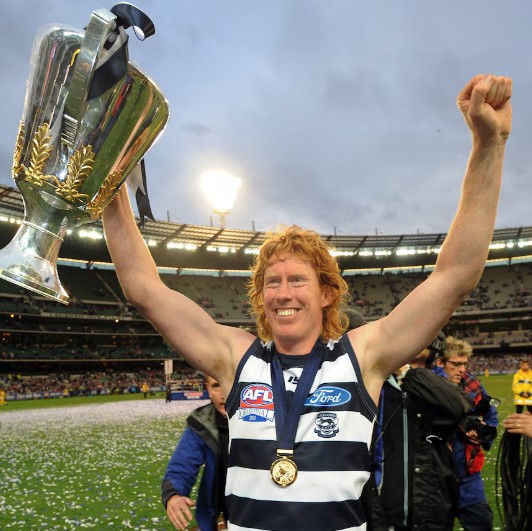
    Cameron Ling proudly wielding the Premiership Cup after Geelong defeated Collingwood in the 2011 AFL Grand Final

    Kane Cornes:

    No discussion about tagging in the AFL would be complete without Kane Cornes.

    Before the topical, controversial and unwavering media personality, Kane Cornes was a hard-running, accountable midfielder for Port Adelaide. A four times John Cahill Winner, two-times All-Australian, a premiership and 300 game player for Port Adelaide, Cornes’ career was one defined by his doggedness and endurance, which were key attributes highlighting his skilfulness as a tagger.

    Cornes, an elite runner; had incredible endurance and a versatile ability to slot into wherever the team needed him. However, like Ling, Cornes’ effectiveness as a tagger also came from his ability to win his own footy, and contribute to Port both as a defensive outlet, or an offensive contributor. Always dedicated to the cause, Cornes had many duels with some of the competitions best midfielders like Gary Ablett Jr, Sam Mitchell and Daniel Kerr.

    But Cornes’ best tagging role undoubtedly came in the most important game in Port’s history. The 2004 Grand Final. Cornes was sent to Simon Black, the 2002 Brownlow Medallist and 2003 Norm Smith Medallist. Black’s impact on that Brisbane team was palpable, winning the 2003 Norm Smith with a monstrous 39 disposals. Enter, Kane Cornes. The brash and brazen 21-year-old was given Black as his assignment on the biggest stage; and he succeeded. Black, who had been so damaging the Grand Final previous, was suffocated to just 15 disposals by Cornes’ incessant presence. The asphyxiation of Simon Black thus allowed Port to run away 40 point winners and end Brisbane’s dominant dynasty.
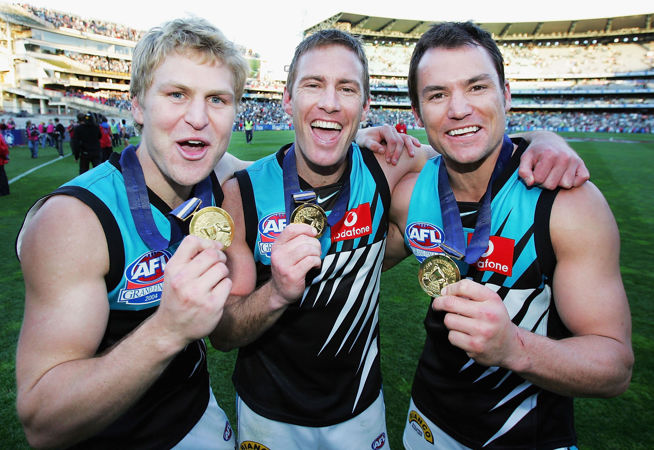
    Kane Cornes, Jarrad Schofield and Brett Montgomery flaunting their 2004 Premiership Medals (Photo by GSP Images, 2004)

    Tagging and its return in modern-day AFL:

    In AFL nowadays, there has been a noticeable resurgence to the prominence of the tag. In a game that has been increasingly decided by the work of the midfielders, coaches are now far more likely to account for those All-Australian quality players that can hurt them late.

    The game has changed, and players need to be adaptable. When certain players are getting off the chain early, coaches need to be able to pull a switch on the fly, and ensure they can have someone responsible for these players — especially if there is no designated tagger on the team. Players like Alex Neal-Bullen (ADL), Jarrod Berry (BRI), Josh Dunkley (BRI), Conor Nash (HAW) and Mark O’Connor (GEEL) have been vital instruments to nullify the impact of some of the league’s most dangerous players.

    I interpret the tagging role different to most. To me, they are hitmen, assassins, mercenaries. Their entire job is to break the spirit of their direct opponent, a return to one on one football in the time of zone/team systems. Imagine them as the seeker in Harry Potter. Their entire role concerns a completely different task from the rest of the team, but they can be immensely vital in victory. Whilst critics will often use statistics to identify whether a player has been well stopped; statistics don’t convey the success of the tag, as they cannot quantify the restriction of these players influence. Any player can get junk possessions, but it is their effectiveness that is inhibited.

    There is nothing better than a team with a designated tagger. Hawthorn have recently relied on Finn Maginness to nullify the danger of Nick Daicos. His 2023 suffocation on Nick Daicos ensured the then Brownlow favourite was starved, restricted to only 5 disposals and 1 clearance. The tag was so successful that Daicos rested forward to shrug Maginness, which ultimately resulted in his early substitution after a collision with James Blanck. Maginness’ assassination of Daicos was pivotal coaching that helped the 16th placed Hawthorn run away 32 point winners against the Ladder Leaders — and probably was the reason Daicos did not win the Brownlow Medal in 2023.
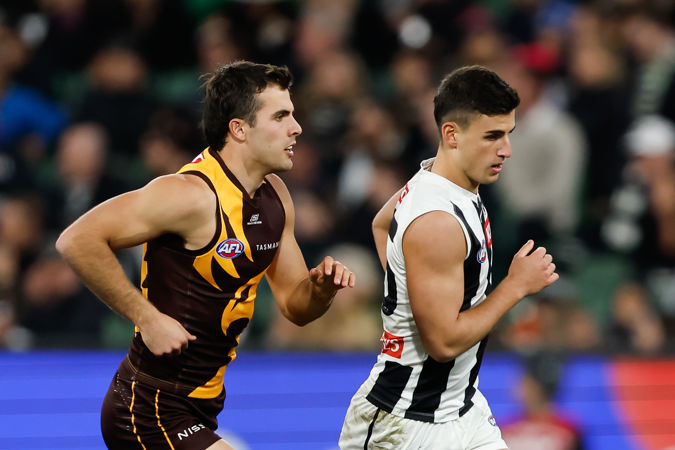
    Finn Maginness stalking Nick Daicos as Hawthorn hosted Collingwood at the MCG, Round 21 2023 (Photo by Dylan Burns/AFL Photos)

    The arrival of Nick Daicos has almost necessitated the return of the tag in the modern game. Already a Rising Star, Premiership Player, two-time All-Australian and Collingwood Best and Fairest in only his fourth year, he is a pure talent that defines the chemical makeup of Craig Mcrae’s Collingwood.

    The Daicos effect has now ensured some coaches really value the use of a tagger each week, not just for certain opponents. Geelong coach Chris Scott has largely given his Irish athlete Oisin Mullin some big shut down roles on players like Nick Daicos, Zak Butters and Jason Horne-Francis; all of which have been integral in some big wins. St Kilda’s Marcus Windhager is Ross Lyon’s resident ball-winning negator, with some immense scalps on Kysiah Pickett and Max Holmes being further complimented with high disposals and an ability to hit the scoreboard. GWS’ Toby Bedford is Adam Kingsley’s tagging talisman, beginning his defensive accountability with a shutdown role on Zak Butters Round 14 2024. Bedford found his niche with this role, with his most notable shutdowns of players like Lachie Neale (2024) and Nick Daicos in Opening Round 2025 being particularly effective.

    But, there is one tagging performance of recent memory that I believe was a critically deciding factor in the last day of September. Collingwood do not win the 2023 Grand Final against Brisbane without Billy Frampton’s work in negating Harris Andrews. Whilst Frampton’s statistical output (2 disposals) is often compared against Andrews’ relatively impactful game (16 disposals and 9 marks), Frampton’s influence is seen in his presence. Frampton’s role was purely negation, and in keeping Andrews defensively honest to limit his defensive impact. Frampton’s role as a decoy to occupy Andrew’s attention was vital in allowing Collingwood to score through other means, with Norm Smith Medallist Bobby Hill kicking 4 goals, as Brisbane’s best intercept defender remained occupied by the interminable Frampton. Frampton is a player that thrives with a sole directive. When given a direct responsibility, a direct opponent, he excels, and his Grand Final performance is perfectly indicative of this trait, greatly influencing the 2023 Grand Final, and etching himself into Collingwood folklore, forever.
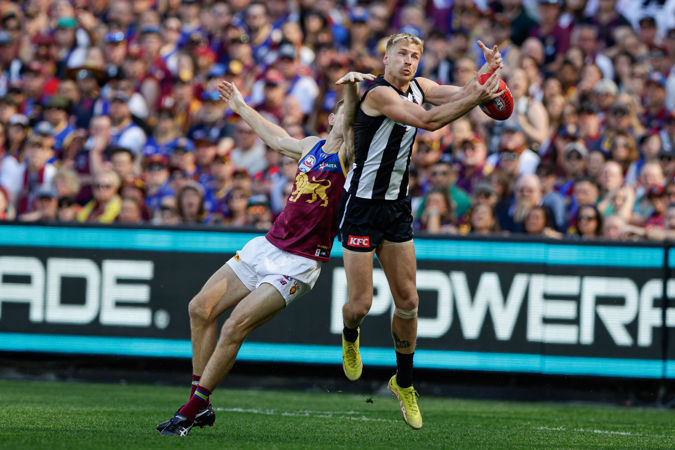
    Billy Frampton forcing Harris Andrews’ to be defensively accountable during the 2023 AFL Grand Final between Collingwood and Brisbane (Photo by Russell Freeman/AFL Photos)

    ThreeQuarterTime is built on the celebration of the Unsung Heroes, to applaud the tactics and strategies that may not necessarily be the sexiest. But, there is something poetic, something pure, about one on one matchups in team sport. About watching two players tussle in physical bouts, where only the strongest, fastest and fittest can survive and thrive. Taggers can prove that the best star players, can bleed — and if it can bleed, teams can kill it.
  • In praise of Geelong’s Irish Experiment

    In praise of Geelong’s Irish Experiment

    Janus Journal #1 – By Hugh Wilkins

    The Irish experiment. For some fans, the thought of the Irish players breeds excitement. For others, the Irish players are a source of frustration. But for me, the Irish players come to represent more than just the game.

    I feel a kindred spirit with the AFL’s Celtic warriors. A connection. I am not Irish myself, but I identify with these players because I can identify and relate to their experiences greater than the typical draftee. You must understand, my love for AFL has only blossomed in the last six years. Despite my constant exposure to AFL (for my Dad was a coach), I only truly began to appreciate it from a perspective of consciousness. Thus, my identification with the Irish imports can be understood. Like them, I am also learning the game; learning the nuances and intricacies, but also learning to love it from a conscious perspective.

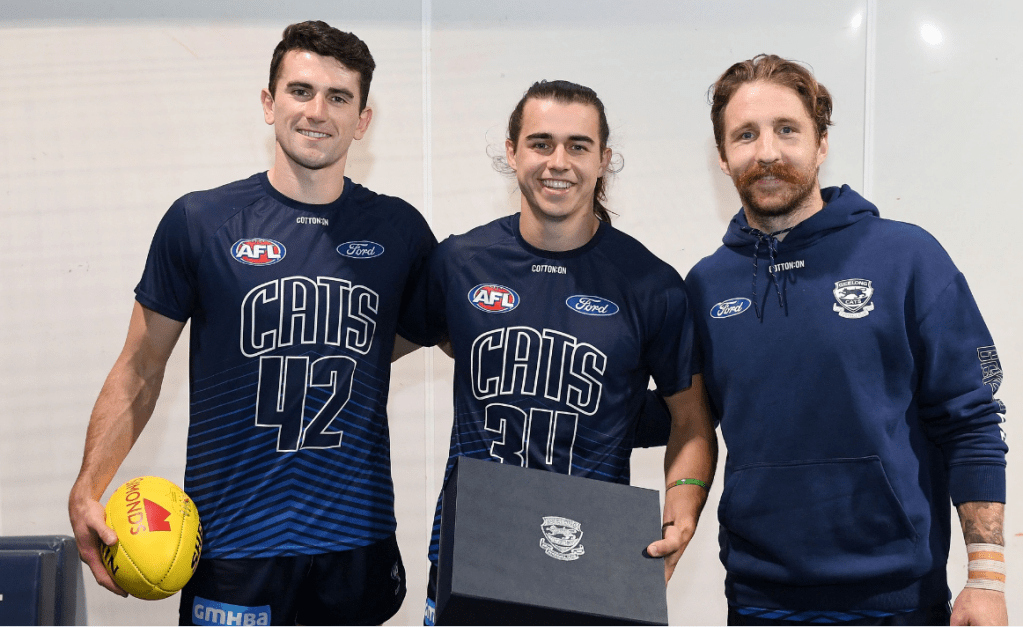
    Luckily for me, Geelong, my team, has a strong history of engaging in this Irish experiment, starting particularly towards the end of the 2016 season, when Zach Tuohy requested a trade from Carlton to Geelong. Along with this, Geelong selected Mark O’Connor from Kerry GAA as a Category B Rookie in October 2016. Both Tuohy (Round 1: Fremantle) and O’Connor (Round 7: Essendon) made their club debuts in 2017, and have become immortalised as stalwart defenders and, most notably, Geelong Premiership Players (2022). Subsequently, Geelong have continued delving into the Irish pool with their selection of Oisin Mullin as a Category B Rookie from County Mayo (Initially in 2021, before eventually coming to Geelong in 2023). This trend has continued even today- as the Cats have filled the Irish void left by Tuohy’s retirement with the Category B Recruitment of youngster Cillian Burke.

    That’s the thing with the Irish. AFL clubs will continue to look down this avenue due to its historical successes, and the capacity to bring through already hardened, tough, resilient and athletic players who have shown a capacity to quickly adapt to the similar, but different, rigours of AFL Football.

    So, forgive the long article, but please indulge me as I wax lyrical about Geelong’s Irish players, and how they have had an impact on me as a Geelong supporter.

    Zach Tuohy

    1x Premiership Player (2022)

    1x All-Australian (2015)

    The frolicking Irishman, with a booming right peg and a penchant for a barrel. Initially drafted by Carlton in 2010 (pick 73 in the Rookie Draft) from his native Portlaoise- Tuohy gradually developed into a consistent, reliable and memorable player. Like most Irishmen, he learnt the trade as a tagger, before slowly drifting into his half-back role with a tendency to roll forward and use his thumping kick to bomb goals from 50; Tuohy’s first goal for Geelong against Fremantle comes to mind (2017).

    For me, I took notice of Tuohy in his time at Geelong. His windswept hair and voluminous moustache made him an instant cult figure. A real heart and soul player that fought for the jumper, the Cats stood taller with Tuohy in the half-back line. A mobile half-back with drive and desire to push up the ground. His mobility correlated with his tackling ability and his wiliness around goal. His Gaelic attributes enabled his craftiness around goal. Look up his two goals within 2 minutes against Brisbane in 2021; a one point win for the Cats. The first showcased Tuohy’s Gaelic capacity to step through traffic, weaving through both Charlie Cameron and Hugh McCluggage for an impressive leaning goal. The second was indicative of Tuohy’s hard running capacity and ability to stay dangerous within the same contest- feeding a handball to Shaun Higgins on the boundary line and getting it back with a no looker for a cheeky checkside goal.

    What struck me about Tuohy was his embracing of physicality. Playing against Western Bulldogs at Marvel Stadium in 2022, Tuohy told Bailey Smith where he could shove it amidst a Three Quarter Time fracas from some Bulldogs players against Rhys Stanley. Tuohy, first to the scene, defended the ruckman, resulting in an iconic, fierce and fiery altercation with Bailey Smith as he ended up headbutting Tuohy.

    But that’s what you got with Tuohy. A fire that burnt as bright as his hair. A fire that could not be snuffed out. One of the most passionate players I have ever seen.

    His reliability and consistency could be seen in his eventual surpassing of the great Jim Stynes record for most games played by an Irish player.

    Tuohy has many iconic moments in the annals of Geelong’s history (His classic Irish jig whenever he kicked a goal or his 250th Game being the Grand Final against Sydney in 2022). But his most notable moment has to be his goal after the siren against Melbourne in 2018. Going into the last term, Geelong where down by 23 points, were a last ditch effort to win the game with a minute to go came from a bold kick in board from Daniel Menzel to Tom Hawkins (who kicked four in the last quarter), to get it to Mitch Duncan, with a foray kick forward to find a now forward Tuohy who takes an aerially powerful contested mark and converted after the siren to win by two points.

    Mark O’Connor:

    1x Premiership Player (2022)

    When compared to Tuohy, Mark O’Connor is a player that receives little to no fanfare. Instead, he has quietly and deliberately found his way into fairly consistent stints in the side. Debuting in 2017, and with 130+ games for the Cats; O’Connor has developed into a reliable and stalwart defender for the Cats.

    Like is apparent to most Irish players, O’Connor’s greatest attribute is his resolute physicality. Always temperate on the field- O’Connor is able to stoically complete his designated assignment. His defensive determination often goes unnoticed- but are often critical to the team’s success. His defensive physicality has become apparent in his willingness to staunchly tag (particularly memorable are his duels with Lachie Neale- Round 6, 2024, O’Connor was able to quell Neale’s influence and was even able to work hard in getting a goal himself), commit to contests as well as his ability to use his strength to help set up goals or get on the end of some team movement; which is exactly how he finds himself as a stalwart member of Geelong’s defensive setup. Look at O’Connor’s goals too. His Irish-ness allows for the capacity to flush them on the run, or craftily snap around his body (O’Connor’s goal against Melbourne or the Bulldogs in 2020 come to mind).

    A reserved and commanding member of Geelong’s backline, he plays with a stoic seriousness that reflects his intensity and physicality. That’s what strikes me about O’Connor. His quite-ness is indicative of his assuredness.

    In 2022, along with Zach Tuohy, O’Connor became a Premiership Player , with Tuohy and O’Connor becoming the second and third Irish players to play in a Premiership since Tadgh Kennelly (2005). In a game where not much was to be done defensively- O’Connor finished the game with 13 disposals at 92% efficiency; and most notably, getting a holding the ball tackle on James Rowbottom on the stroke of 50 to deny Sydney from adding another to their only solitary first quarter goal.

    Oisin Mullin

    The third player in this article is Oisin Mullin, a player that i will always staunchly defend. No matter how poor a game he plays, or how much certain fans think he is to blame for certain results, I will resolutely support and defend Mullin, for there he is an incredibly capable, dynamic and intelligent athlete who is still developing his understanding of the game, and is having to do so on the fly. As a new player still learning the game, he can become a whipping boy for Geelong fans, but there is something inspirational about seeing a player- far from his home, his family, learning a new game that is similar but deeply nuanced and confusing compared to the Gaelic Football he grew up with. How can you not be inspired by this?

    I think we are seeing an immense and positive step in the development of Oisin Mullin. To the outside eye, Oisin Mullin is an easy target for criticism, but I can see the potential that is gradually becoming more and more apparent. Mullin’s best feats have occurred as a tagger. In the Round 9 game against Port Adelaide at GMHBA Stadium, Port jumped the Cats to go into Quarter time with a 5 goal lead; spearheaded by the midfield destruction led by Horne-Francis (8 disposals, 4 score involvements, 1 goal, 3 clearances). Chris Scott dragged Ruckman Rhys Stanley and immediately inject Mullin onto the dangerous Horne-Francis. Despite the loss, Mullin was able quell the impact of Horne-Francis, nullifying him to only 2 score involvements and 4 clearances for the rest of the game; and this was the match where I became invested in the Oisin Mullin development. This match-up was also critical to Geelong’s thumping Qualifying Final against Port Adelaide. Away from home and with a late withdrawal from Tom Stewart- Mullin was brought into the side to again, sit on Horne-Francis and negate his influence.

    In Round 3, 2025, Mullin was placed on the dangerous Charlie Cameron; and after conceding a first quarter goal- locked in and was able to keep Cameron to only 7 disposals, and 2 score involvements, whilst Mullin himself had 15 disposals and 100% efficiency in a wet and slippery environment that probably suited his Gaelic attributes.

    In Round 7 2025 Mullin was tasked with Nick Daicos, a match up I watched quite intently whilst at the game. In the last quarter, with Geelong’s lead at a slender 7 points, Mullin persisted with the tag; and was able to effectively negate Daicos to only 3 disposals. Although Geelong was well within their rights to lose that game from a commanding position (Crisp missed after the siren), Mullin’s disablement of Daicos instrumentally denied his ability to find influence in the game in clutch moments where he historically breaks the game open as a game-winner.

    That is not to disregard his adapting development in the skills department. His most iconic moment surely must be his beautiful left foot hit up running on the Members wing to Brad Close who set up Ollie Henry for his third goal. Unfortunately, the game proved to be a heart-breaking Prelim defeat as the Cats were felled by the Lions by 10 points.

    Mullin is obviously highly rated internally by Geelong. He has found himself a consistent spot in the side in 2025, so Chris Scott evidently sees something in the developing Irishmen. Oisin bias aside. I genuinely do think it is only a matter of time before we see Oisin break the shackles of development and becomes a respected Irish footballer in the vein of Zach Tuohy. We have seen what he can do, and i believe he is more than just a flirting experiment. He is most valued and effective as of writing as a tagger- especially on midfield players. Oisin’s current position as a defender often leaves him an easy target for criticism; especially in losses. But, watching Mullin live, i do see an athlete with a resounding composure that just hasn’t found the capacity to release it yet. That’s why I believe no one should be surprised if they find Oisin spending far more time in the midfield. He is a tough and brick-walled with a tank for days for two way running. He has the capacity to attack the ball hard, and use his speed to burst or weave through contests, and with an ability to use his Gaelic attributes and natural speed to dexterously change his running patterns on a dime, but to also find targets with the cheeky, angled kicking synonymous with Geelong.

    At Gather Round this year, during a signing event, I even asked Oisin Mullin how he has found the change between Gaelic football and AFL. He spoke to it being a significant change compared to what he grew up playing. Following on, i asked whether he is enjoying, of which he said yes. He spoke to enjoying the challenge of learning this new game on the fly, in a competition where those who can’t adapt get spit out quite quickly. Thus, he has a fire inside, a competitive spirit and desire for adaption and gradual improvement each week.

    Obviously, this article mentions the Geelong Irishmen. I am a Geelong fan, sue me. But that is not to discount the presence of the Irish players around the league. Mark Keane is a regular defender for the Adelaide Crows, recently heroically saving the Showdown no.57 clash with his courageous back-with-the-flight contested mark with 1 minute to go (and his almost unintelligible post-match interview about “footy”). Conor Nash has become a resolute hard-nosed tackling midfielder for Hawthorn, and Connor McKenna, the former bomber, is a premiership player for Brisbane (2024). All of these players have found their footing in the AFL after times of significant development; of learning the game and its intricacies. This is why I relate to the Irish players, because like them, I am learning the game on the run, and it is a great exemplar of the value that the AFL, and Geelong in particular, have found via the Irish Experiment.