Janus’ Journal #7 – By Hugh Wilkins
The Ashes has regained some modern intensity through the 2023 Ashes series. A series fought between two drastically different styles; the methodical patience of the Australians versus the kamikaze “Bazball” style of the English. This Bazball style was displayed on the very first ball of this Ashes series at Edgbaston, as English opener Zak Crawley smacked Australian Captain Pat Cummins for 4.
But this series created many iconic cricketing moments, and reignited the relevance of the phrase “spirit of cricket”, but we’ll get to that shortly. The Edgbaston test created an intense final run chase that echoed the cinema of the 2005 Edgbaston test and the importance of momentum in the patience of test cricket. England has an immensely rapid first innings, anchored by Joe Root’s 118, Captain Ben Stokes declared at 393 to have a pip at Australia at the end of Day 1. Australia responded with a resilient innings, spearheaded by Usman Khawaja’s uplifting 141 and aided by Travis Head (50), Alex Carey (66) and the lower order doggedness of Pat Cummins (38). Australia’s first innings fell 7 short of the English first, and the English’s reckless abandon led to their second innings total rising quickly, but lasting around a day, with consistent middle order contributions; Joe Root (46 off 55), Harry Brook (46 off 52) and Ben Stokes (43 off 66) all highlighted the virulent nature of Bazball. Australia’s second innings would not be as reliable as the first, as the steadfast Khawaja (65 off 197) was left largely on his own, as Stuart Broad tore through the middle order. After Alex Carey fell, Australia were 8-227, needing 54 runs to win as Nathan Lyon came in. But, what happened next would be ripped straight out of a comic book as Pat Cummins and Nathan Lyon were thrust into the middle. 54 runs to win, two batsmen, something that seemed improbable, and was so close to happening in 2005. But this time, with the Australian grit and occasional flair, Cummins and Lyon took control of the game. Cummins unafraid to play aggressively, replacing his mild-mannered demeanour with a Kryptonian heroism as he nailed deliveries from Broad and Robinson in the middle of his bat down the ground or through the covers for boundaries. Lyon showed immense heart, holding the strike and finding his eye with courageous pull shots on the swivel running fine, but his greatest shot was his punishing of Stuart Broad for four over mid-on. Like the 2005 test, Australia found themselves with 3 runs to win, with Cummins on strike. As Ollie Robinson steamed in, Cummins was able to reflexively ricochet the delivery onto the edge of his bat, as it sailed towards the boundary, and was knocked into it by a fielder as Australia ended up winning by 2 wickets, chasing 54 runs in a 9th wicket partnership, and avenging the Edgbaston demons from 2005. Watching this game early in the Australian morning had to be one of the most rewarding sporting results I’ve seen, and one that made me immensely proud of the Australian cricket team.
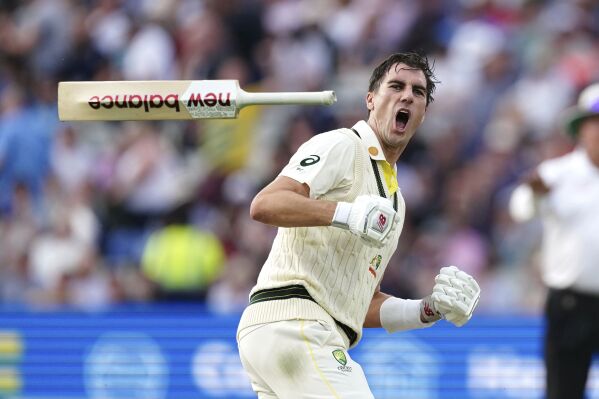
But speaking of pride, this Ashes series, and particularly the second test at Lord’s, brought this element of pride to the cricketing forefront, as the notion of pride was brought into question. It even became a notion of political debate between Prime Ministers.
Coming into Lord’s, both teams were fairly matched given the Edgbaston test being decided on the finest of margins. But at the home of cricket anything can happen. Australia probably entered with some extra confidence despite their away-team status given they had defeated India at Lord’s for the World Test Championship, so were somewhat battle-ready for the ground, but the atmosphere the English bring to Lord’s is different beast entirely.
The match began with Australia being sent into bat amid the grey conditions that seemed to threaten the match, with England hoping to capitalise on the lowered visibility. It seemed a logical choice, but it did little to deter the opening partnership between Australia’s David Warner and Usman Khawaja. A contrasting partnership, as Warner’s aggressive shotmaking was enabled by Khawaja’s resolute defensive mindset to wear the ball and bowler down. Although Khawaja made just 17 runs, he faced 70 deliveries, which facilitated Warner’s balls-to-the-walls 66 off 88. This partnership was important dirty work that enabled Marnus Labuschagne (47) and Travis Head (77) to contribute through the dictating middle-order partnership with Steve Smith, who furthered his Ashes credentials with an almighty 110; whose innings was based on the vision of a jungle predator, remaining watchful for the exact moment to strike. Even the tail-ending Pat Cummins provided a handy 22 runs to give Australia a first innings score of 416.
An immense score whose foundations rested on the first 20 overs, Australia was able to find a delicate combination between their trademark resoluteness and the flashy self-expression afforded at the crease. England would need to bat well to make inroads .
And they did, with the 416 run lead getting whittled down as Day 2 continued on. The conditions cleared up, and openers Zak Crawley and Ben Duckett were able to capitalise on their destructive styles quickly off the mark. The outfield remained quick with the distinctive Lord’s slope, and Crawley and Duckett could flick, sweep and punch the Australian bowlers with ease. Crawley’s foot to the floor embracing of Bazball was evidenced by his 48 off 48 deliveries, and Ben Duckett made a delightful 98 in a heavy metal opening partnership that starkly contrasted the methodism of Australia’s opening partnership. Ollie Pope’s 42 and Harry Brook’s 50 were greatly contributing to England’s staunch devouring of Australia’s lead.
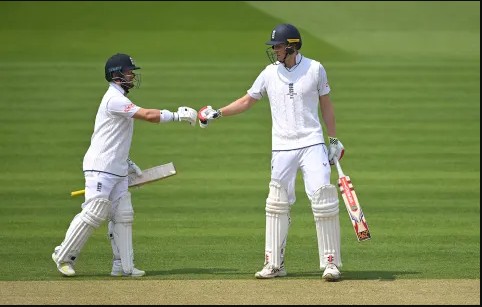
This was only worsened when Australia’s Nathan Lyon, playing in his 100th consecutive test match, popped his calf from an innocuous fielding incident.
But Australia rallied, as Mitchell Starc’s dismissing of Joe Root (10), Harry Brook and Ben Stokes (17) inhibited England’s ability to override Australia’s total, with their rash approach inflicting rash wickets, and England found themselves 91 runs short of Australia.
Despite a strong 77 from Khawaja, the Australian batsmen never gained a comfortable ascendancy in their second innings, clearly haunted by the cruelty of Nathan Lyon’s injury and wearing plenty through the English bouncer barrage as they embraced the Bodyline antics which was so successful in the English tour of Australia (1932/1933). What makes the Ashes special however, is the moments of heroism that these games afford. Despite exploding his calf, as Josh Hazlewood was dismissed, Lyon emerged from the Lord’s long room like a spectre, bravely batting through his injury. Although he couldn’t run, he gave Mitchell Starc the agency to swing freely, helping put a 15 run 10th wicket partnership, 4 runs of which came from an impressive pull shot on Stuart Broad. Lyon the lionheart had rejuvenated the Australian energy at the end of Day 3.
This energy continued, as Mitchell Starc tore through Zak Crawley and Ollie Pope, and Pat Cummins got Joe Root and Harry Brook, leaving England 4-45 at the 13th over. Despite this, Ben Duckett and Ben Stokes were utterly destructive in their 5th wicket partnership, asserting an apocalyptic 132 runs. Duckett’s individually brisk 83 came at a reprieve, as a guiding punch off a Cam Green bouncer sailed to Mitchell Starc who caught the ball at deep fine leg. Although Duckett walked off, the third umpire brought him back to the wicket, ruling that Starc had grounded the ball in the process of catching which meant the catch was void. To the letter of the law, Duckett was not out, but in the moral spirit of the game, Starc had taken a fair catch amid overwhelming English momentum and had only gone to brace himself. As Marnus Labuschagne said: “[Starc] didn’t use the ground to catch the ball”. At the end of the day, the English were gallivanting around the Australians, using the laws of cricket to justify Duckett’s reprieve, who knew he was out.

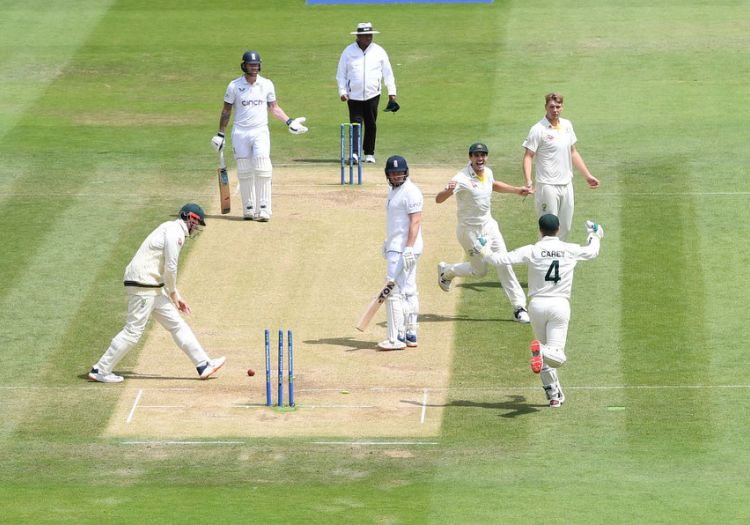
Ironically, this would not be the only question towards the morality/spirit of the rules in this game. On Day 5, England were chasing 258 to win, and Duckett’s exit brought in English Wicketkeeper Jonny Bairstow. With Bairstow’s tendency to attack the bowlers, the Australian tactic of bouncing Bairstow aimed to stem the flow of English runs and disable Bairstow’s fluidity in building into the innings; keeping the attack disjointed. Bairstow’s resoluteness saw him continually duck under the short balls and instantly exit his crease down the wicket to survey the state of the pitch. Almost as soon as he ducked, he exited his crease, while the ball was still in play. The Australian’s saw this, and Pat Cummins simply told Wicketkeeper Alex Carey to have a crack at the stumps on the next bouncer as soon as it came to him.
Cameron Green delivered a bouncer to Bairstow which he ducked, and as soon as the ball half-volleyed to Carey, the wicketkeeper instantaneously unleashed the still-live ball onto the stumps. Unfortunately for Bairstow, he was already 5 feet out of his crease of protection before the umpire could call over, when the bails were hit. The Australians asked the question, and upon digital review, the third umpire had to abide by the same rules of the game that kept Duckett in: that Bairstow was out of his crease, and thus victim to a run out.
As an Australian, I’ll never forget watching Day 5 with my dad at midnight when this moment happened. We had been questioning the Australian bowling at this point, particularly fearful of Stokes and his obvious desire to re-emulate his heroics at Headingley in 2019. As armchair experts through the delirium of a midnight spectating, we devised that Australia needed to do something different to get a breakthrough and hopefully mentally rattle the English. So when Bairstow got stumped, we were immediately in rapture. When the English media began questioning the tactic during the lunch break, we couldn’t help but laugh at the evident hypocrisy that arose by the same media that ruled that Duckett was rightfully given not out by the Mitchell Starc catch. England had been a beneficiary of a cricketing technicality, and it was only fair for Australia to get one back. 1-1. However, it was ironic that when the Starc catch was overruled, the Marylebone Cricket Committee took to twitter to explain the justification of the decision, explicitly citing Law 33.3 to adjudge Starc’s lack of control. But there was no such explanation post after the stumping to explain rule 30.11: “a batter is considered out of [their] crease unless some part of [their] person or bat is grounded behind the popping crease of that end”, or law 20.1.2: “the ball shall be considered to be dead when it is clear to the bowler’s end umpire that the fielding side and both batters at the wicket have ceased to regard it as in play”. Carey’s decision to throw the ball at the stumps instantaneously was an indication that the ball was still live to a Bairstow who had no part of his body or bat in his crease. This became a clear indication of an incensement at a decision which England had benefitted from and justified the day prior.
Even when Stuart Broad came into the crease, clearly outraged by his perception of unsportsmanlike disrespect, and began to exaggeratedly put his bat in his crease and ask whether the ball is still live, my dad and I still noted the hypocrisy. Broad had notably been caught in the furore of another cricketing drama, as in 2013 at Trent Bridge, he had notoriously not walked after clearly nicking a delivery from Australian spinner Ashton Agar directly to first slip. He knew he had hit it, but stayed at the crease, staring down the umpire, who said not out. Broad himself defended his decision with no regrets, as because England won this game by 14 runs, “if [Broad] walked off, [England] would have lost the game”.
So it became funny when Broad had interpreted an almost identical situation concerning the laws of cricket as completely juxtaposing. It’s fine when he does it, but when it is put back on him, he’s enraged. In sport, and in life, if you dish it out, you need to be able to take it back. Moreso, in Australia’s first batting innings, Bairstow himself tried a similar trick to dismiss Marnus Labuschagne, so any form of English outrage about what was coined to be “the spirit of cricket” from figures such as Piers Morgan, and even from English captain Ben Stokes and coach Brendan McCullum are completely neutered. I am certain, that if the shoe was on the other foot, this whole debacle surrounding the morality of cricket would not have occurred.
Despite whatever opinion this incident encouraged, it was clear that Ben Stokes unlocked a venomous motivation to make the Australian’s pay. With a spinner down and on a flat wicket, the short deliveries Ben Stokes was peppered with were easily dispatched with vitriolic disdain to the boundaries (with one over resulting in 4 runs, 4 runs and 6 runs in consecutive balls). The plan to bowl short deliveries played directly into Stokes hand, and he was hell-bent on revenge.

Although the English fell short despite the undeniable and powerful innings of Ben Stokes (155), losing by 43 runs, even with the tail wagging incredibly, the mentality of this new Bazball style was made clear. Whilst their reckless abandon brings about a kamikaze clarity in mindset, with zero fear of wicket, it shows that their gamble that surely one person will pull it off disables any form of sustained team partnership whilst batting, and brings in the opposition even when the game appears in England’s favour. Commentary surrounding this style, and one that I personally agree with, largely from cricket journalists like Adam Collins, is that there is a difference between carefree cricket and careless cricket. Even my personal viewing of cricket as a fan (not just an Australian), I do actually enjoy the spectacle of aggressive test cricket. But for any team to be successful, especially in test cricket, they must have gears. Games last for five days, and because momentum is so apparent within test cricket, teams must withstand pressure when its being inflicted, and counter-punching pressure back when the opportunity arises. Australia’s victory was not down to just the stumping, but it was built in the first innings total of 416, where they showed that their openers could absorb pressure, and allow the subsequent batsman to counterpunch the pressure back, working as a collective unit rather than relying on a bunch of cricketing mavericks.
Ultimately, the 2023 Ashes series was drawn 2-2: as the Manchester test match was called off as a result of rain, with England winning the third test match at Leeds, and the fifth at Trent Bridge. However, I believe that this stumping incident gave England the motivation to finally turn up to the Ashes, and who knows what would have happened to the result had Manchester been played out. But at the end of the day, that’s all it was, potential.
This Ashes series was one of the most dramatic in recent memory, and despite the tremendous display of punishing, intelligent and reckless cricket, it will only be remembered for the theatrical and dramatic return of the spirit of cricket, inflamed by Jonny Bairstow’s lazy saunter down the wicket on Day 5 at Lord’s.




















 ThreeQuarterTime